 Ground Truth
 Property Owners
Property Documentation: Maximizing Value Across the Ownership Lifecycle
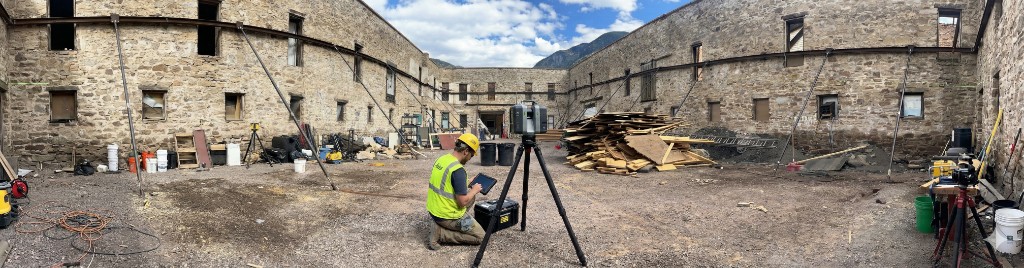
Construction succeeds when bids, schedules, and field work align with the building as it actually exists—not with incomplete record drawings or assumptions carried forward from the last tenant improvement. Existing Conditions Documentation (ECD) gives builders and trade partners a verified geometric and visual baseline: 3D laser scan data, accurate plans and elevations, and where needed, Building Information Models (BIM) that reflect structure, openings, and major MEP routing as encountered in the field.
That baseline tightens estimating, reduces requests for information (RFIs) driven by unknown conditions, and supports clash detection and prefabrication decisions before mobilization. ECD is captured with professional instruments on site, then processed into deliverables your team can drop into CAD, BIM, and coordination workflows—so supers, PMs, and subcontractors share one ground-truth representation of the job.
Renovation and infill projects are especially sensitive to surprises: slab thickness and embeds, column locations, shaft sizes, ceiling interstitial space, and the path of live services. When those details are missing or wrong, the cost shows up as field-directed changes, trade stacking, and schedule compression—not as a line item anyone priced confidently at bid time.
ECD addresses the gap early. Measured geometry supports anchor planning, penetration layouts, and equipment paths; paired photography or 360° documentation helps remote team members understand constraints without repeated site walks.
Scope can be tailored to the contract and phase of work: from targeted scans of critical areas to full-floor or whole-building coverage. Deliverables often include 2D plans and sections, point cloud archives, and model-ready data for coordination. The same dataset can be revisited for future phases, claims support, and as-built updates after work is complete.
Professional documentation is a small share of construction value relative to the cost of a single major field conflict or a week of delay on a constrained site. Engaging ECD during preconstruction or immediately after award preserves optionality: better bids, fewer surprises at installation, and clearer communication with owners and design teams when conditions differ from the record set.
Property Documentation: Maximizing Value Across the Ownership Lifecycle
Accurate plans and models fast
2D Plans, 3D models and thorough Photo Documentation
Planning for transition, growth and safety with ECD
Efficient, profitable, property operation and management with ECD
ECD: The Blueprint for Flawless Events
Cost Reduction and Risk Mitigation in Construction
An accurate foundation for success in modern landscape architecture
Planning a renovation, TI, or ground-up build? Discuss scope, deliverables, and schedule with our team.
Get in TouchA comprehensive list of types of buildings, sites, and campuses Ground Truth 3D has scanned, with links to content where available.
Discuss scope, deliverables, and timeline with our team.
Get in TouchStart with a conversation about your documentation needs.
Get in Touch