 Ground Truth
 Property Owners
Property Documentation: Maximizing Value Across the Ownership Lifecycle
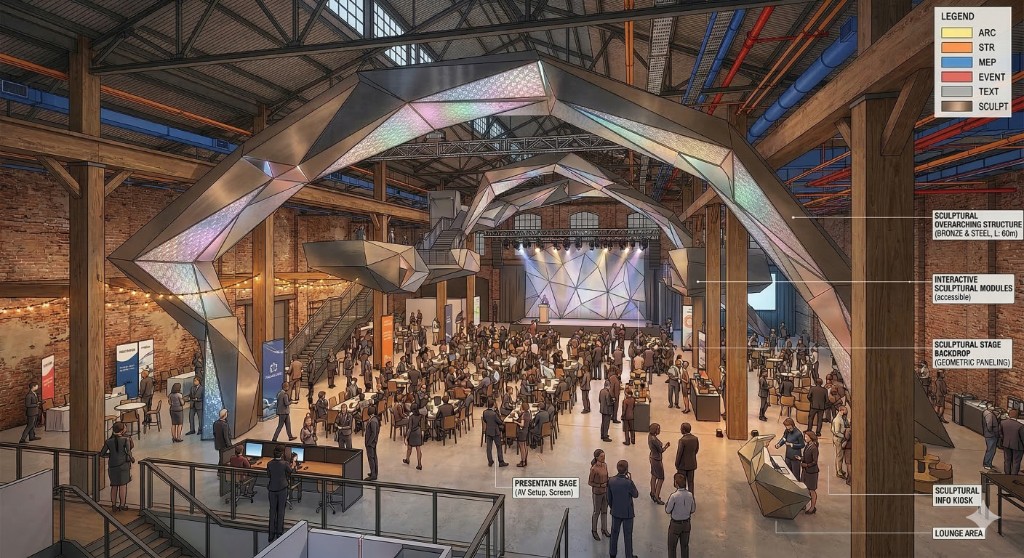
Large-scale events depend on precise knowledge of the venue: floor loading paths, ceiling heights and rigging capacity, door and dock dimensions, and the real location of mechanical, electrical, and plumbing (MEP) systems. Relying on incomplete drawings or memory invites surprises at load-in—when there is no time left to recover. Existing Conditions Documentation (ECD) captures the building as it exists today and turns it into a dimensionally accurate digital record: laser scan data, verified plans, Building Information Models (BIM) where appropriate, and navigable photographic documentation.
For event planners and production teams, that record is the common language between the venue, designers, riggers, A/V, catering, and safety stakeholders. It supports confident space planning, permits and life-safety reviews, and clear communication with vendors who may never visit the site until the day of the build. ECD is typically produced using 3D laser scanning (LiDAR), structured photography or 360° capture, and rigorous office processing to deliver drawings and models that match what is on the ground—not what was imagined on an old plan set.
Ballrooms, convention halls, warehouses, and mixed-use venues are often altered over years of renovations and tenant improvements. Published floor plans may omit structural columns at the correct offset, understate slab slopes, or misstate the routing of fire suppression and power. For temporary builds—stages, scenic elements, truss, seating decks, and rigged loads—those gaps translate directly into schedule risk and cost exposure.
ECD closes the gap by anchoring decisions in measured geometry and current conditions. Teams can confirm clearances for flown elements, reconcile sight lines and egress with actual door placements, and coordinate cable paths and power drops against real conduit and service locations—before trucks arrive and the clock starts.
Depending on scope, deliverables can include accurate floor plans and reflected ceiling plans, sections and elevations, BIM or 3D models for coordination, and photo or 360° tours for remote stakeholders. Together, they reduce rework, shorten on-site survey time, and make it easier to align creative intent with venue constraints and code expectations.
Professional ECD is a modest fraction of overall production spend but disproportionately reduces the likelihood of last-minute field fixes, overtime rigging, or compromised guest experience. Engaging early— ideally during programming and schematic layout—maximizes the return: the same dataset can support multiple bid cycles, option studies, and future events at the same location.
Property Documentation: Maximizing Value Across the Ownership Lifecycle
Accurate plans and models fast
2D Plans, 3D models and thorough Photo Documentation
Planning for transition, growth and safety with ECD
Efficient, profitable, property operation and management with ECD
ECD: The Blueprint for Flawless Events
Cost Reduction and Risk Mitigation in Construction
An accurate foundation for success in modern landscape architecture
Planning a high-stakes event in a complex venue? Discuss scope, deliverables, and schedule with our team.
Get in TouchA comprehensive list of types of buildings, sites, and campuses Ground Truth 3D has scanned, with links to content where available.
Discuss scope, deliverables, and timeline with our team.
Get in TouchStart with a conversation about your documentation needs.
Get in Touch