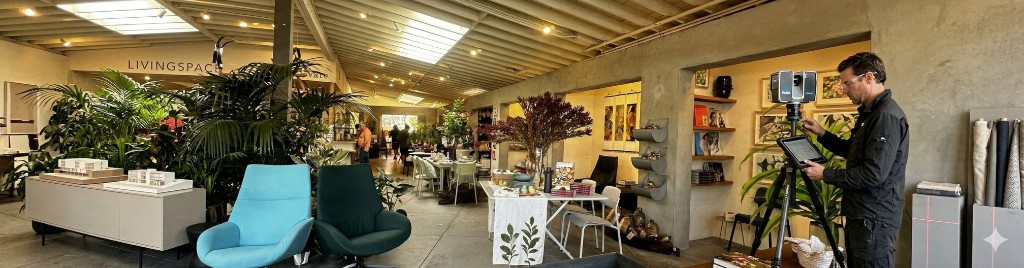
Wide interior of a furniture showroom with a technician operating a tripod-mounted 3D laser scanner and tablet

Existing Conditions Documentation for Retail

Retail is Detail

Overview

The retail sector operates under the foundational maxim, "Retail is Detail". A successful modern retail build-out is a balancing act, requiring the seamless integration of customer experience factors, merchandising, store flow, and aesthetics, with essential functional necessities such as storage, point-of-sale (POS) systems, and security infrastructure.

Before any construction begins, project teams face a labyrinth of challenges, including navigating local zoning, securing permitting, and ensuring stringent compliance with ADA accessibility and building codes. Critically, undocumented or non-compliant pre-existing conditions introduce significant financial risks that can derail schedules and budgets. By leveraging comprehensive existing conditions documentation, project teams can maximize opportunities for cost savings by efficiently reusing or modifying existing storefronts and interiors, while mitigating the financial risks associated with unknown variables.

The Benefits of Existing Conditions Documentation

Read more

Comprehensive existing conditions documentation is an investment that yields measurable benefits across a project's lifecycle, primarily through the following value-focused applications:

  • De-risking Renovation: Documentation provides crucial clarity on the reusability of architectural elements (e.g., walls, floors, ceilings) and systems. This information ensures that any element planned for reuse meets current building codes and aligns with the new aesthetic goals, thereby avoiding costly late-stage demolition or remediation.
  • Cost Control and Efficiency: Accurate data enables precise budgeting by identifying necessary modifications to critical utilities, including electrical service, data wiring, and lighting systems. This foresight is vital for accommodating new fixtures, POS terminals, and digital displays without incurring expensive change orders or construction delays.
  • Installation Readiness: Precise documentation facilitates the pre-planning for major retail elements. This includes the infrastructure requirements and exact placement of fitting rooms, specialized display shelving, cash wraps, and complex security systems, which actively minimizes costly on-site installation delays and ensures everything fits the first time.
  • Compliance Assurance: By proactively documenting the current state of the space, project teams can immediately identify and address any discrepancies related to ADA accessibility requirements and prepare for necessary local safety inspections, ensuring a smoother and faster regulatory pathway.

Deliverables

Modern existing conditions documentation moves beyond traditional methods, leveraging advanced 3D capture technologies to create high-fidelity, measurable "ground truth" data sets:

  • Point Cloud Data (LiDAR): This is the foundational deliverable, consisting of a highly accurate, measurable, three-dimensional model of the existing space. LiDAR technology captures millions of data points, allowing for measurements and analysis that are accurate to within millimeters.
  • Intelligent 2D Drawing Sets: These are architect or designer-ready plans, elevations, and sections that are generated directly from the Point Cloud. Unlike manual drawings, these intelligent sets ensure absolute dimensional accuracy for all subsequent architecture, engineering, and construction planning, eliminating measurement errors.
  • As-Built BIM Models: For clients utilizing Building Information Modeling (BIM), a detailed, three-dimensional model of the existing conditions is provided. This model is immediately usable by design teams to place new elements and coordinate disciplines, maximizing the benefits of a BIM workflow.
  • Annotated Utility Schematics: These include clear reports and visualizations of critical systems, such as electrical, plumbing, and HVAC. These schematics are spatially referenced and overlaid directly onto the 3D model, allowing teams to pinpoint exact utility locations, assess capacity, and plan connections with certainty.

Process for Effective Documentation

Effective documentation relies on a standardized, high-tech process to ensure comprehensive, verifiable data capture:

  • LiDAR Scanning Interior and Exterior: High-definition LiDAR scanners are deployed to capture every architectural and structural detail of the interior and exterior of the retail space, forming the dense Point Cloud data set.
  • 360° Photography: High-resolution 360° photography is simultaneously employed to thoroughly document the visual and textural aspects of the space. This visual context is essential for remote coordination and verifying material conditions.
  • Drone Photography (If Applicable): For sites with complex roof systems or exterior facades, drone photography is used to capture data of the roof and upper structures. This ensures a complete as-built record, including systems like rooftop HVAC units and parapets.

The shift toward accurate, 3D-based existing conditions documentation transforms the retail construction pipeline from a process fraught with uncertainty into a predictable, detail-driven execution. By providing ground-truth data, projects secure better cost control, mitigate regulatory risks, and achieve installation readiness, ultimately accelerating time-to-market and protecting the brand's investment.

Who we serve

Planning a flagship opening, chain-wide rollout, or tenant improvement? Discuss capture scope, deliverables, and schedule with our team.

Get in Touch

Property types documented

A comprehensive list of types of buildings, sites, and campuses Ground Truth 3D has scanned, with links to content where available.

Discuss scope, deliverables, and timeline with our team.

Get in Touch

Services

Recent blog content

Start with a conversation about your documentation needs.

Get in Touch