 Ground Truth
 Property Owners
Property Documentation: Maximizing Value Across the Ownership Lifecycle
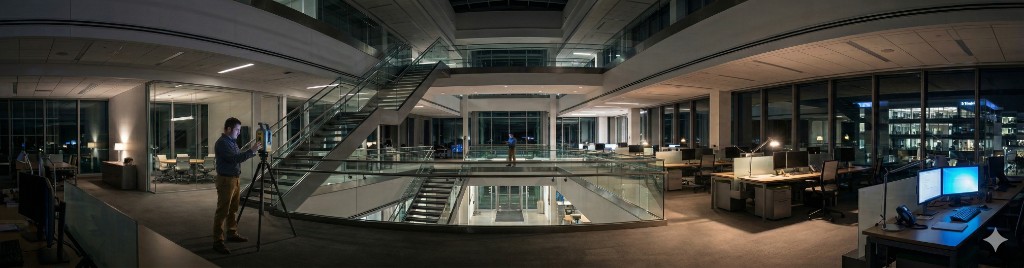
The primary goal of any commercial building renovation is to cost-effectively increase the property's value, whether by boosting worker productivity, improving lease rates, or increasing investment returns. Achieving project success is fundamentally dependent on a clear and easily communicated understanding of the building's current state, which facilitates planning and helps prevent the conflict, delays, and rework that often afflict large-scale property alteration projects.
Existing Conditions Documentation (ECD) provides a comprehensive, accurate, and up-to-date digital record of a building's current state, which remains available to authorized parties throughout the entire project lifecycle, from initial investment evaluation to eventual sale. This vital documentation is delivered in industry-standard formats and gives all process participants critical data regarding the building's layout, systems, structure, and condition.
Vital components of ECD include:
Generating reliable, design-ready ECD involves a highly coordinated effort to capture the physical reality of the structure. The general process includes five key steps:
ECD projects frequently take place in occupied commercial buildings, introducing complexities like security concerns, privacy issues, and the potential for tenant interruption. Firms experienced in this area, such as Ground Truth 3D, utilize established processes to address challenging environments, including working with client security teams, using flexible scheduling (overnight and weekend scans), and securing all collected data with provisions to exclude sensitive areas from documentation.
The primary value of Existing Conditions Documentation lies in risk mitigation and project efficiency, established by providing accurate baseline information.
ECD provides value by:
While detailed costs vary based on the building's size, age, and complexity, generating ECD typically ranges from $.35 to $1.50 per square foot. The cost of documentation is far outweighed by the resulting savings from avoiding major design changes, construction delays, and change orders. The upfront time invested in comprehensive documentation is often the single greatest factor in accelerating the overall project schedule and ensuring successful, on-budget completion. In summary, ECD transforms the inherent uncertainty of an existing building into a clear, shared reality for all project participants.
Contact us for an Existing Conditions Documentation Quote.
Get in TouchProperty Documentation: Maximizing Value Across the Ownership Lifecycle
Accurate plans and models fast
2D Plans, 3D models and thorough Photo Documentation
Planning for transition, growth and safety with ECD
Efficient, profitable, property operation and management with ECD
ECD: The Blueprint for Flawless Events
Cost Reduction and Risk Mitigation in Construction
An accurate foundation for success in modern landscape architecture
Planning a commercial renovation? Discuss capture scope, deliverables, and schedule with our team.
Get in TouchA comprehensive list of types of buildings, sites, and campuses Ground Truth 3D has scanned, with links to content where available.
Discuss scope, deliverables, and timeline with our team.
Get in TouchStart with a conversation about your documentation needs.
Get in Touch